The Reubin Askew and Preston Haskell Scholars program identify an outstanding cohort of undergraduate researchers selected for their commitment to public service, in either domestic or international spheres.
Askew Scholars’ projects focus on domestic policy issues, while Haskell Scholars’ projects engage with international affairs.
View the 2025-26 Cohort
Who should Apply?
Any UF undergraduate from any college or major is invited to apply. Askew and Haskell Scholars are typically advanced students pursuing original research.
NOTE: University Scholars or CLAS Scholars cannot hold both awards unless they can clearly demonstrate two entirely different research subjects.
Specific Qualifications
Students are required to have a 3.0 GPA and have at least two full semesters remaining before graduation. Research topics can pertain to any discipline but should connect to the mission of the Bob Graham Center: public service, civic engagement, and public leadership.
Requirements for Completion
Students must successfully complete their project within the Academic Year in which they are awarded. Students must also regularly engage with the Center in research workshops, and publicly present their project, usually at the Center’s annual undergraduate research symposium in April.
How much is the Award?
Both Askew and Haskell Scholars will receive $2,000 to support a significant research project.
NOTE: The scholarship will be disbursed in two installments ($1,000 in Fall and $1,000 in Spring).
Faculty mentors receive a $1000 in professional development funds transferred to their academic departments.
How do I apply?
Applications for the 2026-2027 cohort will open in February 2026. Applicants are required to complete on online application that includes a 300 word personal statement of interest and a 500 word project proposal. Applicants must attach a resume and letter of support from a faculty member.
Submit a Research Programs Interest Form – and be notified about upcoming dates and deadlines!
Application Timeline for the 2026-27 Cohort
February 11, 2026: Applications Open
February 17, 2026: Lunch time Info Session
March 4, 2026: Applications Closed
March 13, 2026: Applicants Notified.
April 2026: Scholars orientation with Bob Graham Center faculty
For questions on the program contact Dr. Teresa Cornacchione, Undergraduate Research Coordinator, tcornacchione@ufl.edu
About Reubin Askew
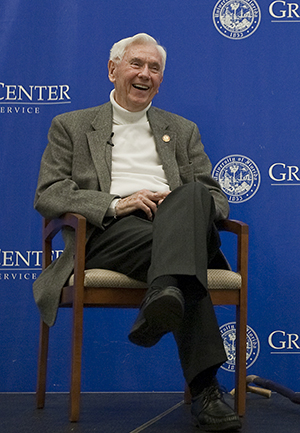 Reubin O’Donovan Askew (1928-2014) served as Florida’s 37th Governor from 1971 to 1979. He is consistently ranked as one of the greatest governors in the state’s history, and rated by the John F. Kennedy School of Government at Harvard University as one of the United States’ top 10 governors of the 20th century.
A native of Muskogee, Okla., his family settled in Pensacola during his childhood. He served in the U.S. Army after graduating from high school. In 1951 he graduated from Florida State University with a degree in public administration, then completed law school at the University of Florida College of Law.
Askew was first elected to public office in 1958 in the Florida House of Representatives, then served in the Florida Senate from 1962 till election as governor in 1970. Askew’s reform agenda included extensive funding for public education, environmental protection, the state’s first corporate income tax, and improved race relations.
After leaving the governor’s office, Askew served as the U.S. Trade Representative and briefly mounted an unsuccessful campaign for the Democratic nomination for the presidency in 1984. The Askew School of Public Administration within Florida State’s College of Social Sciences and Public Policy is named in his honor. He spent much of his retirement lecturing in Florida’s universities. Askew died in 2014 from complications of a stroke.
This research program furthers Governor Askew’s legacy of education and civic engagement by supporting the next generation of public servant scholars.